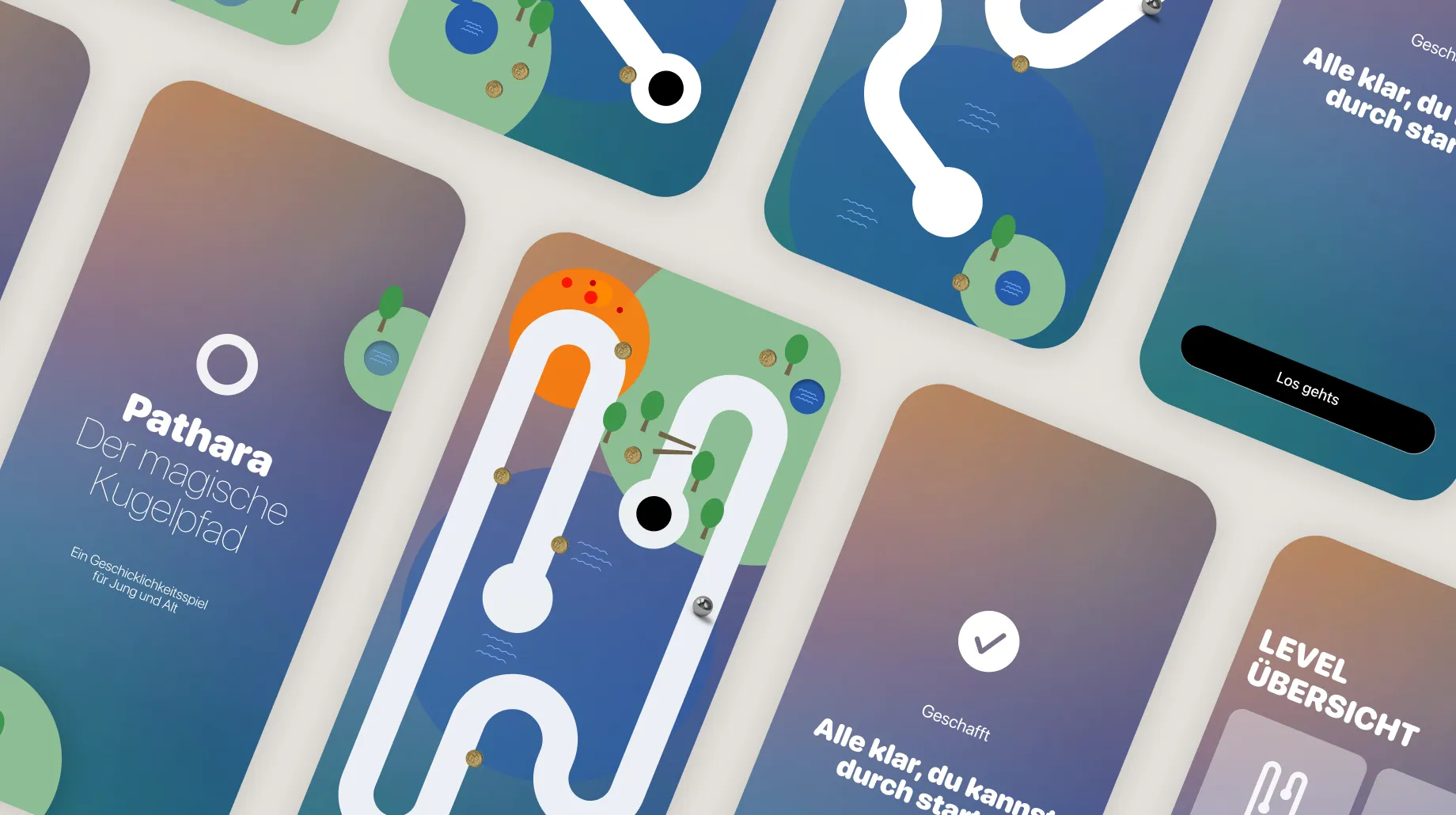
The magical ball path — a skill game for young & old
Pathara · iOS App · Personal
- Role
- Idea, Concept, Design
- Code
- Claude Code
- Platform
- iOS
- Type
- Game app
- Status
- active
A briefing from my own son
The best project ideas rarely come out of a meeting. Pathara came from my son — with a clear vision: a ball, a path, and the tension of rolling off at the wrong moment. For me, the appeal lay in a simple principle: it's not the thumb that steers, but the hand. You tilt the actual device, and the ball rolls along a narrow white corridor. Sea and lava lurk all around. The fastest way is almost never the best. Those who rush, fall. Those who stay calm, get through. It became a game that deliberately slows things down: no highscore drum-beating, but the quiet goal of getting the ball safely to the end — "for young and old".
How does "balance" feel right?
A game controlled by the tilt of the device lives or dies by the feel. From this one thing, a whole catalogue of questions quickly emerged:
How much tilt is right — fast enough for tension, calm enough for control?
How do I build a sensor game that doesn't frustrate children in the very first level?
Which obstacles punish, which only slow down — and where is the fair line?
And the most exciting: can I bring the player's real environment into the game?
From tilt to the camera as playing field
The core is the controls. The iPhone's motion sensors are translated into physics in real time, so the ball feels natural — not jittery, not sluggish. This is also where the answer to the frustration question emerged: three modes. In turtle mode, the sensor input is very gentle, so that children in particular don't fail immediately; alongside it a normal mode; and for skilled players the rabbit mode, in which every movement counts instantly.
Then the world itself. It is built in clear layers: sea and lava are real traps — falling in means losing a life and starting over. Trees, in contrast, are just bollards: the ball bounces off without penalty. Small lakes act as tunnels and teleport the ball from A to B. And a fair protection rule applies — as long as the ball rests on the white corridor or on an island, the lava beneath is harmless. Mountains mark the passage into additional side worlds.
The most interesting layer is the lowest: the live camera. The device looks downwards, and the blurred camera image forms the ground of the game world. Anyone who steers the ball outside the visible camera area restarts the level. That way, everyone plays in their own real environment — no run looks the same twice.
Technically, the levels are created entirely in Figma and translated directly into the app via an interface — coordinates, colors and the path itself are read out and rendered procedurally, not embedded as an image. Design and game thus always remain the same source — one change, effective everywhere.
What the game can already do
Tilt controls: the ball follows the actual movement of the device, not the thumb.
The camera as playing field: the iPhone's blurred live view forms the ground of every world.
Traps & obstacles: sea and lava cost a life, trees only slow you down, lakes serve as tunnels.
Three difficulty modes: Turtle (gentle, child-friendly), Normal and Rabbit (for skilled players).
Collect & dare: gather coins and treasures, risk shortcuts.
Three-star rating: based on time and coins collected.
Multiple worlds: from forest to ice, each with its own look; currently around ten hand-designed levels plus a level overview.
What comes next
More levels & worlds: further sections are already designed — the implementation is mainly waiting for one thing: time.
Fine-tuning the balance: further adjusting the tuning between turtle and rabbit, so that the right pace is there for every hand.
More replay value: small incentives that motivate you to improve your own run, without disturbing the calm underlying feel.
It's in your own hands
Pathara started as a commission from my son and became something I enjoy playing myself. Perhaps because it follows a small rule of life: the fastest way is rarely the smartest, and you have the most control when you stay calm. That time is "somewhat in the way" of the whole thing fits the game almost too well. Here, too, the rule applies: don't rush. The further levels will come — at the right angle.