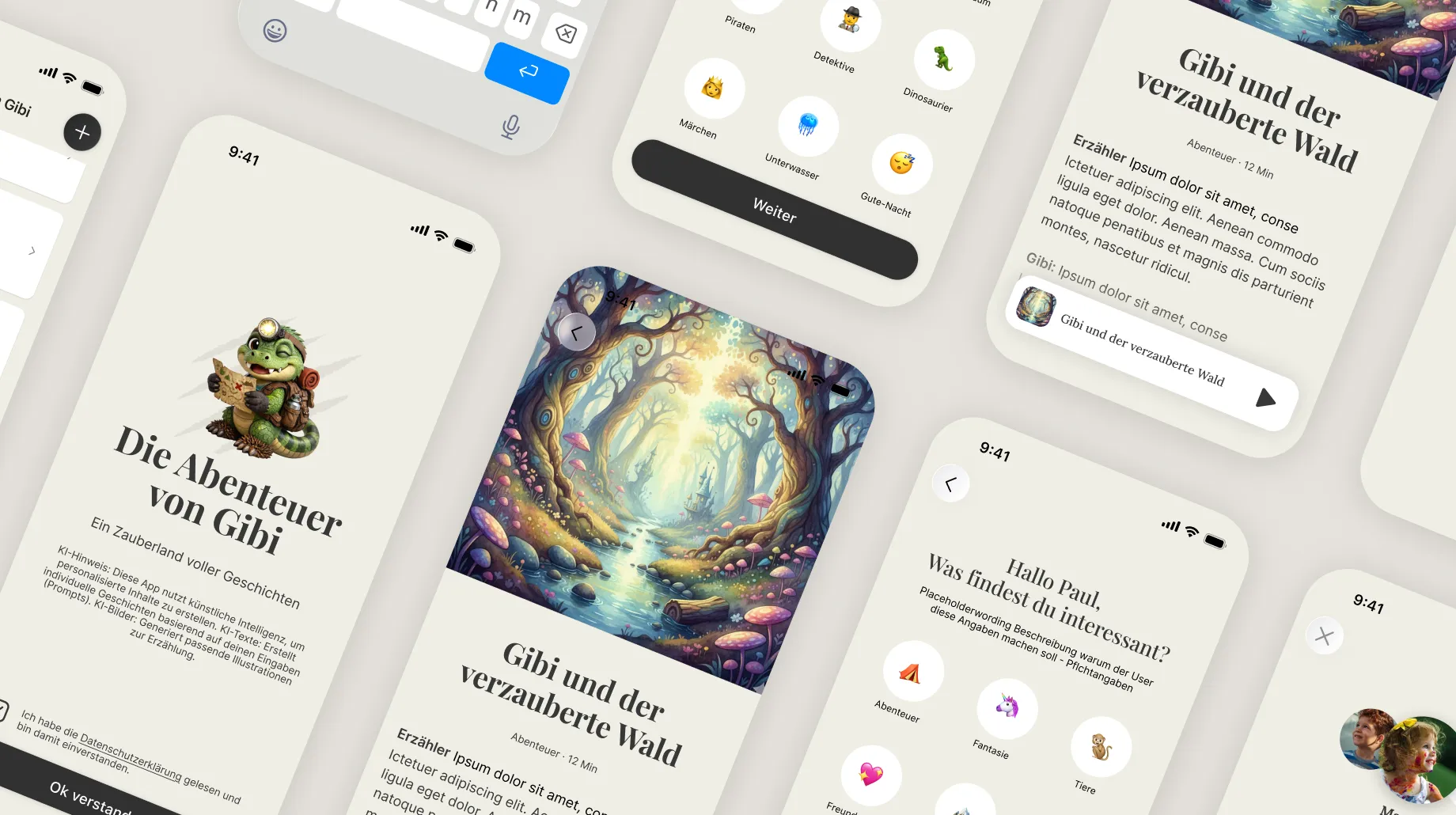
Gibi's Adventures · iOS App · In Progress
Your imagination, your adventures.
Born from my kids' freely invented car-ride stories about a fantasy character called Gibi — an app where children build their adventures themselves.
Story Time · Back Seat
- Role
- Idea, Concept, Design
- Code
- Claude Code
- Platform
- iOS App
- Type
- Interactive Storytelling App
- Status
- active
Gibi — who is that, really?
On the way to kindergarten, my two children constantly told me stories they had made up themselves — and almost always about "Gibi". At first I had no idea who that was supposed to be. When I asked, they described a fantasy character only they can see: hedgehog feet, crocodile body, snake tail, mole hands with a headlamp, plus a backpack and a map.
The stories jumped back and forth without any recognizable thread — often no longer reconstructible the next day. Impressed by this boundless imagination, I began to wonder how it could be captured. Simply writing it down or recording it missed the actual idea — what was more exciting was how children could build their stories themselves. That is how Gibi's Adventures came about.
I didn't start with the technology, but with the character. First it was just a sketch — which I then loaded into 3D software. The visual translation thrilled me: suddenly Gibi was tangible. Being able to connect the name with a real figure was, for me, the first step in pursuing the idea seriously.
During research came the setback: such ideas had long existed. I was briefly disappointed — until I asked myself who I was actually doing this for. It was never about monetization, but first and foremost about my children. So I didn't drop the idea, I kept going.
A growing list of questions
What started as a small prompting experiment that turned a few inputs into stories quickly became a whole catalog of questions:
- How should the stories actually be created — how much does the user contribute?
- Can you choose between genres, maybe even create your own characters?
- Should every story have a learning effect?
- Can the text be read aloud — and if so, how?
In Dialogue with the AI
The free APIs turned out to be inconsistently reliable. Sometimes it was about images that were supposed to be generated automatically from the text — the title cover. Sometimes it was about plots that weren't cleanly structured. The topics drifted further and further from UX and UI and became increasingly complex.
The biggest challenge was structuring the prompts in a way that the AI could actually follow them in the end and not get lost in too many details. Hallucination was a major problem at first — also because I initially worked only in the terminal. As someone who thinks visually, I later regretted not using the graphical app from the start. The layouts, on the other hand, were built entirely in Figma — I wasn't going to give that up.
The exchange between my own ideas and the AI's suggestions felt at times like genuine collaboration. The initial frustration over hallucinations and recurring standard errors had an unexpected upside: the real learning effect lay in structuring my own requests more clearly and working more deliberately.
In the end it was a whole bundle of APIs and AI systems I had to constantly coordinate. The result: without significant costs on my side, a user can currently create three stories per day. Intended as bedtime stories, that is more than enough.
What the app can already do
- Choose a genre: it defines the basic tone of the story.
- Custom characters: created via trait prompts.
- Automatic visuals: generated from the produced text.
- Karaoke read-aloud mode: with visually distinguishable characters.
What comes next
- Livelier visual worlds: No longer static, but subtly animated — ideally by genre or automatically from the story. How exactly, is still open.
- Voice integration: I'm currently trying out what the iPhone offers out of the box. In English, you can already use your own voice; in German, not yet — maybe it helps to just wait.
A father should really read aloud himself
Pure AI voices don't feel quite right for stories like these — a father should really read aloud himself. Hence the idea: record your own voice in sections and have AI overlay it onto the generated texts.
That takes time, which is often in short supply right now. Until then, it stays with a familiar family line: "Dad, when are you going to keep going?" There isn't a reliable answer yet.